|
The PNG (Portable Network Graphics) is a
method to store images by compressing images with no loss of
information. PNG files can store colors with up to 48 bits
per pixel and gray scales with up to 16 bits per pixel.
Moreover, it can also store an optional alpha channel for
transparency. When PNG is used in the connected network, it
can correct gamma and color of images automatically. So you
can accurately render the images on different display
devices.
EMF (Enhanced Metafile)
is a metafile format designed by Microsoft, and a successor
to the older WMF format. EMF is a newer 32-bit version with
additional commands. It is easy to read on MS Windows
computer while harder to read on other platforms. EMF files
are usually stored between 5 to 10 KB in size, and EMF
images do not support transparency. The EMZ format is a
compressed version of the EMF format. EMF+ is an extension
to EMF that allows GDI+ records to be stored. There are two
variations on the EMF+ format: EMF+ Only and EMF+ Dual.
BMP (Bitmap) is very popular nowadays due
to the common use of Windows. That is because BMP is the
standard format used by Windows for saving image files. It
contains more image information than the JPEG, and there is
almost no compression of images. So it takes a larger disk
space. Presently, 24 bits per pixel BMP files are the most
common in all the 1, 4, 8, 15, 24, 32, 64 bits per pixel BMP
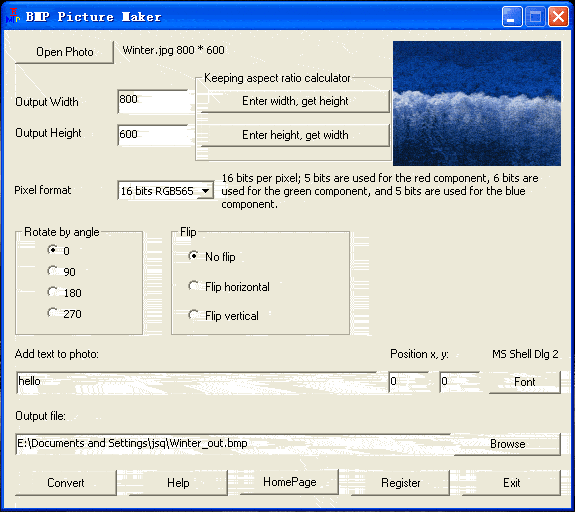
files.To convert png emf to
bmp file,
please download
BMP Picture Maker.

Other image
format definition:
PDF means Portable Document Format which is a electronic
document format developed by Adobe Systems in 1993.
Supporting cross-platform, it becomes the ideal document
file for data exchange on the internet. PDF could even pack
text, fonts, formatting, colors, and device-independent
graphic images in a file, which overweighs highly over other
electronic document. |
|