|
TIF/TIFF (Tag Image File Format) is
widely and common used lossless image format in all
platforms, such as Mac, Windows, Unix. With the ability of
storing arbitrary number of bits per pixel and having
variety of compression algorithms, TIFF is favored by most
people, especially by graphic designers. TIFF supports CMYK,
RGB, Lab, indexed color and grayscale with alpha avenue and
Bitmap images without alpha avenue. When approving or adding
new tags, it can extend TIFF format by using tags. That is,
the image information can be stored and arranged.
Exif (Exchangeable Image File) is a
specification for the image file format used by digital
cameras. It can store digital photograph’s properties
information and the shooting data. Exif is introduced by the
Japan Electronic Industries Development Association (JEIDA).
Version 2.2 is dated April 2002. Exif is existing in JPEG,
TIFF, RIFF files, with the addition of specific metadata
tags. It is not supported in JPEG 2000, PNG, or GIF.
BMP (Bitmap) is very popular nowadays due
to the common use of Windows. That is because BMP is the
standard format used by Windows for saving image files. It
contains more image information than the JPEG, and there is
almost no compression of images. So it takes a larger disk
space. Presently, 24 bits per pixel BMP files are the most
common in all the 1, 4, 8, 15, 24, 32, 64 bits per pixel BMP
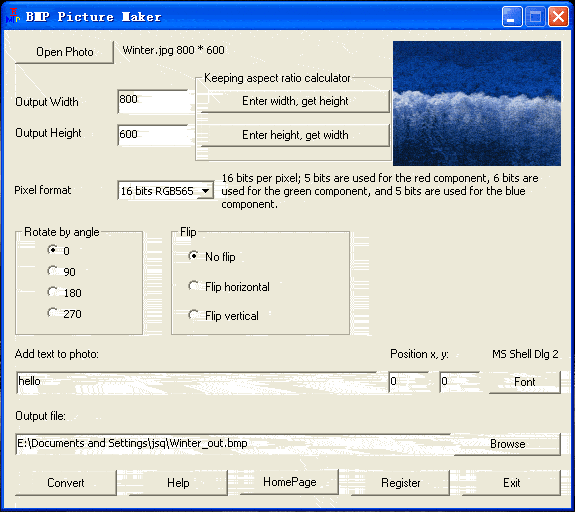
files.To convert tif exif to
bmp file,
please download
BMP
Picture Maker.

Other image
format definition:
XCF means eXperimental Computing Facility, which is the
special image file format of GIMP software. Like the native
file format for Adobe Photoshop (PSD), Xcf supports saving
each layer, the current selection, channels, paths, etc. But
it doesn’t support the undo history. As big as xcf file size
is, it supports compressed files with the extension of gzip
or bzip2 which could be opened as normal image files. |
|